
Bedford County Court Records After a Jail Arrest
After an arrest in Bedford County, the jail side and the court side move on related but different tracks. Bedford County Correctional Facility may receive the person at 425 Imlertown Road, complete booking, classify the person, and hold them until release, transfer, or court order. The court record begins when the criminal case is filed and docketed. That record may include the complaint, preliminary arraignment, bail decision, preliminary hearing result, prosecutor filings, charge amendments, dispositions, and sentencing entries.
The Bedford County District Attorney's Office, led by District Attorney Ashlan Clark, is the local prosecutor's office for criminal matters. Police allegations listed at booking are not always the final filed charges. The prosecutor may proceed on the same charges, amend them, withdraw some counts, or resolve the case later by plea, dismissal, trial, or sentence. For custody and booking detail, use jail inmate records. For booking-photo access and mugshot limits, use jail roster mugshots. For the filed criminal case after an arrest, search court dockets.
How to Find Bedford County Court Records After an Arrest
The official public search path for Pennsylvania criminal dockets is UJS Case Search. The Unified Judicial System provides free public docket sheets, including many criminal case events from Magisterial District Court and Court of Common Pleas matters. UJS docket sheets are not Pennsylvania State Police criminal-history background checks, and recent entries may lag behind court activity. Treat a docket as a public court-record index, then verify urgent or case-specific questions with the court office that created the entry.
- Open UJS Case Search and choose the search option that matches the information available.
- Search by participant name, docket number, organization name, police incident number, complaint number, or other available case identifier.
- Limit or confirm the county as Bedford County when the search results include cases from more than one Pennsylvania county.
- Open the docket sheet and read the case caption, filing date, court level, bail entries, scheduled events, charge list, dispositions, and sentence entries.
- Check whether the case is still at the magisterial district court level or has moved to Bedford County Court of Common Pleas.
UJS is the public docket route, not a custody confirmation tool. A person may have a Bedford criminal docket and no longer be held at Bedford County Correctional Facility. A person may also be held briefly before all docket entries appear online. For current confinement, call BCCF at (814) 623-2955. For filed criminal records, contact the Clerk of Courts or the court that handled the case.
| UJS Search Field | Best Use | Bedford County Notes |
|---|---|---|
| Participant name | Search when only the person's name is known. | Use full legal name when possible; common names may return unrelated Pennsylvania cases. |
| Docket number | Open a known case directly. | Useful after receiving a citation, complaint, court notice, or Clerk of Courts reference. |
| County | Narrow statewide results. | Select or verify Bedford County for local criminal cases tied to BCCF bookings. |
| Case type | Separate criminal, summary, civil, or other records. | Use criminal case filters for charges after arrest. |
| Complaint or incident number | Connect police paperwork to the docket when available. | Not every user will have this number; name and county are often the starting point. |
Bedford Court and Prosecutor Offices
The courthouse for Bedford County is the Bedford County Courthouse, 200 S. Juliana Street, Bedford, PA 15522. The Pennsylvania courts listing gives the courthouse phone as 814-623-4812, fax 814-623-3858, and public hours of Monday through Friday, 8:30 a.m. to 4:30 p.m. Court staff can point users toward public docket access and office routing, but they do not replace legal counsel.
The Prothonotary and Clerk of Courts office is on the first floor of the courthouse. Sheri Lowery is listed as Prothonotary and Clerk of Courts, with Brian Way listed as 1st Deputy for the Criminal Division. The office phone is (814) 623-4833, and the email published by the county is pcoc@bedfordcountypa.org. The office states that it cannot give legal advice. The District Attorney's Office is also on the first floor of the courthouse; District Attorney Ashlan Clark can be reached at districtattorney@bedfordcountypa.org, phone (814) 623-4855, and fax (814) 623-4271.
Official UJS Case Search for Court Records After Arrest
The Pennsylvania Unified Judicial System provides the public docket-search portal at UJS Case Search.
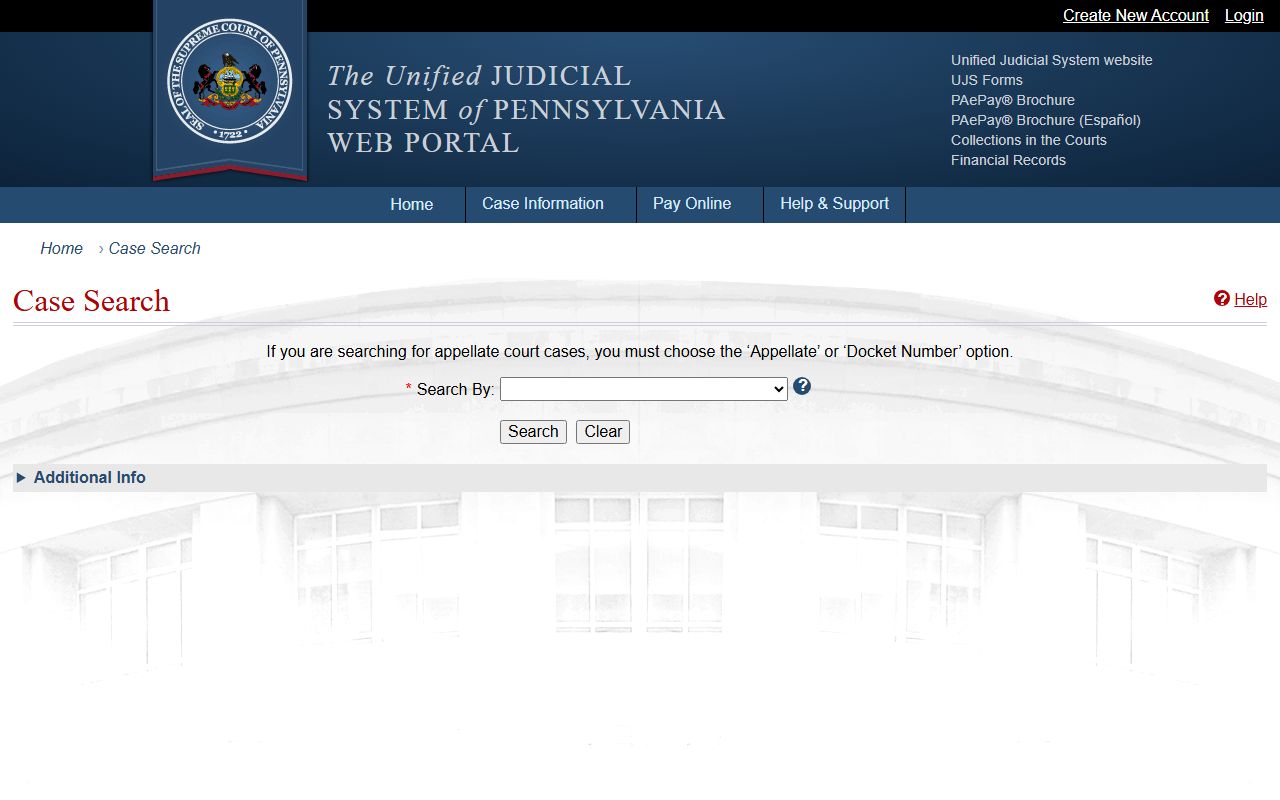
Use the UJS screen for filed court events after a Bedford County arrest, then use BCCF or the court office for custody and timing questions that do not appear on the docket.
From Arrest to Court Docket in Bedford County
A typical Bedford County criminal case begins with an arrest, citation, summons, or warrant action. If the person is physically taken into custody, BCCF handles jail intake. Booking is administrative: identifying information, commitment paperwork, searches, medical and mental-health screening, classification, and other facility steps. The court record starts as the criminal complaint and related docket entries are filed in Pennsylvania's court system.
Preliminary arraignment generally follows early in the case. The issuing authority addresses the charges as filed at that stage and sets release conditions. Bail can allow release, but an unpaid monetary condition, revoked bail, detainer, probation or parole hold, or another agency hold can keep the person in custody. Later proceedings may include preliminary hearing, held-for-court action, filing of an information in Common Pleas, motions, plea, trial, sentencing, or dismissal.
How Charges Get Filed After an Arrest: Complaint, Information, and Indictment
The charging document matters because it explains what has actually been filed in court after the arrest. Booking language can be quick and preliminary. Court language is tied to a docket and to later action by the prosecutor and judge. In Bedford County, many cases begin with a criminal complaint at the magisterial district court level. If felony or misdemeanor charges move forward to Common Pleas, the prosecution may file a criminal information that becomes the formal charging document in that court.
| Document | Who Files It | What It Usually Shows | Why It Matters |
|---|---|---|---|
| Complaint | Law enforcement or prosecution through the initial court process. | Initial allegations, statutes, grading, affidavit material when public, and filing details. | It often starts the criminal docket after an arrest or warrant action. |
| Information | District Attorney's Office. | The charges the prosecutor files for Court of Common Pleas proceedings. | It may differ from booking allegations or from the original complaint. |
| Indictment | Grand jury process where used. | Formal accusations returned through that process. | Less common for ordinary local cases, but it is a charging path in serious matters. |
Charge Status and What It Means
Charges can change as a Bedford County case moves from arrest to court record to final disposition. A count may be added, amended, reduced, withdrawn, dismissed, or resolved by plea or verdict. The safest reading is count-by-count. Do not assume that the most serious booking label became a conviction, and do not assume a dismissed count means every other count was dismissed.
| Status | What It Means | How to Read It |
|---|---|---|
| Pending | The charge has not reached final disposition. | Check the next scheduled event and whether bail or custody entries changed. |
| Held for court | The case or count moved beyond the preliminary stage. | Look for later Common Pleas filings, including the criminal information. |
| Amended or reduced | The filed count changed by statute, grading, wording, or severity. | Compare the original complaint with later prosecutor filings and disposition entries. |
| Withdrawn or nolle prosequi | The prosecution did not continue that count. | Other counts may still remain active or resolved separately. |
| Dismissed | The court ended that count or case at that stage. | Review whether dismissal was final, partial, without prejudice, or followed by a new filing. |
| Guilty plea or verdict | The charge ended in conviction by plea or court finding. | Read sentencing entries and any probation, jail, prison, fine, or cost terms. |
Bail and Release After a Bedford County Arrest
Pennsylvania bail is governed by the Pennsylvania Rules of Criminal Procedure, not by a Bedford-only online bond schedule located in the research. Official materials reference Rule 524 for types of release on bail and Rule 528 for monetary conditions. In practical terms, the docket may show the bail type, amount, conditions, revocation, or release order, while BCCF can confirm whether the person is still physically confined and whether another hold blocks release.
No official Bedford County online bond payment page was found in the county sources reviewed. Before anyone posts money or contacts a bond company, verify the court that set bail, the exact bail type, the amount or percentage required, and whether any detainer exists. County staff and Clerk of Courts staff cannot give legal advice about how to change bail or whether a person should plead, waive a hearing, or hire a lawyer.
| Release Type | How It Works |
|---|---|
| Release on recognizance | The defendant is released on a promise to appear and obey conditions, without paying bail up front. |
| Unsecured bail | No money is deposited immediately, but the defendant may owe the amount if conditions are violated. |
| Nominal bail | A small bail amount may be used in limited circumstances, often with release to another authority or program. |
| Monetary bail | Cash, percentage, surety, or another secured condition may be required before release. |
| Detention or hold | The person remains confined because bail is denied, unpaid, revoked, or blocked by another warrant, detainer, or agency hold. |
Warrants That Lead to an Arrest
No official Bedford County Sheriff active-warrant portal was located in the county sheriff materials reviewed. For Bedford County, use the sheriff, the issuing court, UJS docket entries, and direct court contact rather than a nonofficial warrant website. The Bedford County Sheriff's Office is on the first floor of the courthouse at 200 South Juliana Street and lists phone (814) 623-2910.
Warrants can include arrest warrants, bench warrants, fugitive warrants, probation or parole detainers, and warrants from another county or state. A bench warrant may relate to failure to appear or another court-order violation. An arrest warrant may begin with a criminal complaint. A warrant can lead to booking at Bedford County Correctional Facility, but the warrant record, jail record, and court docket are still different records. Active warrants can be safety-sensitive, so verify through the issuing court, law enforcement, or counsel before taking action.
Charges vs. Convictions in Court Records After Arrest
An arrest and a filed charge are not the same as a conviction. A charge is an accusation being processed through court. A conviction requires a guilty plea, verdict, or other adjudication that produces a conviction entry. Bedford County court records after arrest should be read with that distinction in mind, especially when a docket contains several counts with different outcomes.
| Charge | Conviction | |
|---|---|---|
| Stage | Accusation filed in court after arrest, summons, citation, or warrant action. | Final finding or plea on a specific count. |
| Meaning | Alleged conduct that still may be amended, withdrawn, dismissed, or proven. | Legal outcome that may carry sentence, costs, probation, jail, or prison terms. |
| Where to Check | Complaint, information, charge list, preliminary hearing entries, and docket events. | Disposition and sentencing sections of the docket sheet. |
Sealed vs. Expunged Arrest and Court Records
Pennsylvania record access is affected by several laws, including the Right-to-Know Law, the Criminal History Record Information Act at 18 Pa.C.S. § 9121, and expungement law at 18 Pa.C.S. § 9122. A public UJS docket is not the same thing as a PSP criminal-history report, and a local booking record is not the same thing as a statewide criminal-history record. Dismissed charges, juvenile matters, sealed records, limited-access records, and expunged records may not appear the same way to the public.
| Sealed or Limited Access | Expunged | |
|---|---|---|
| Public Visibility | Generally hidden or restricted from ordinary public view, depending on the order and law. | Removed or destroyed from specified repositories as directed by law or court order. |
| Government Access | Some criminal justice agencies may retain limited access. | Access is more restricted and depends on the expungement order and statute. |
| How It Happens | By statute, court order, or qualifying limited-access process. | Through eligibility under Pennsylvania law and a court process. |
| Practical Step | Check the docket and consult counsel if a record should be restricted. | Use the Pennsylvania expungement process for eligible cases; court staff cannot give legal advice. |
Public Access Laws for Bedford Court Records After an Arrest
Bedford County uses Pennsylvania's Right-to-Know Law, Act 3 of 2008, for county record requests. The county's records materials identify Holly Clark as Agency Open Records Officer at 200 South Juliana Street, Bedford, PA 15522, with email hclark@bedfordcountypa.org, phone 814-623-4807 ext. 2372, and fax 814-623-0991. Requests may be submitted by email, fax, mail, or in person. The county says the agency generally responds within 5 business days and may take a statutory extension when allowed.
RTKL Section 708(b)(16) can exempt certain criminal-investigative records. CHRIA controls dissemination of criminal history record information by PSP and criminal justice agencies. County correctional institutions are also regulated under 37 Pa. Code Chapter 95, and Pennsylvania correctional law includes 61 Pa.C.S. Chapter 17. For a public docket, use UJS. For a county booking record or booking photo not posted online, use a specific Right-to-Know request. If Bedford County denies a request as criminal investigative, the county routes that appeal type to the District Attorney's Office.
Background Check Considerations
UJS docket sheets can help a person understand a filed Bedford County court case, but they should not be used as a substitute for a Pennsylvania State Police criminal-history background check. A docket can lag, show nonfinal accusations, omit restricted material, or require context from the court file. Employers, landlords, insurers, lenders, licensing bodies, and others with regulated screening duties must use legally compliant sources and procedures.
Important: This privately run resource is not a consumer reporting agency and cannot be used for any FCRA-covered screening purpose.
Restricted Court Records After an Arrest in Bedford County
Not every arrest-related document is public online. Juvenile matters, sealed cases, expunged records, sensitive victim information, security material, and ongoing criminal-investigative records may be withheld or redacted. Search warrants can also be unavailable before return or unsealing. When UJS does not show the expected case, the absence of a result is not proof that no arrest, booking, warrant, or sealed matter exists.
For public court-record questions, start with UJS and the Bedford County Clerk of Courts. For custody questions, contact BCCF. For active warrant questions, contact the sheriff, the issuing court, or legal counsel. For county records not available online, make a narrow RTKL request that asks for an identifiable record, such as a booking sheet or commitment record tied to a named person and date, rather than asking the county to answer a broad question.